
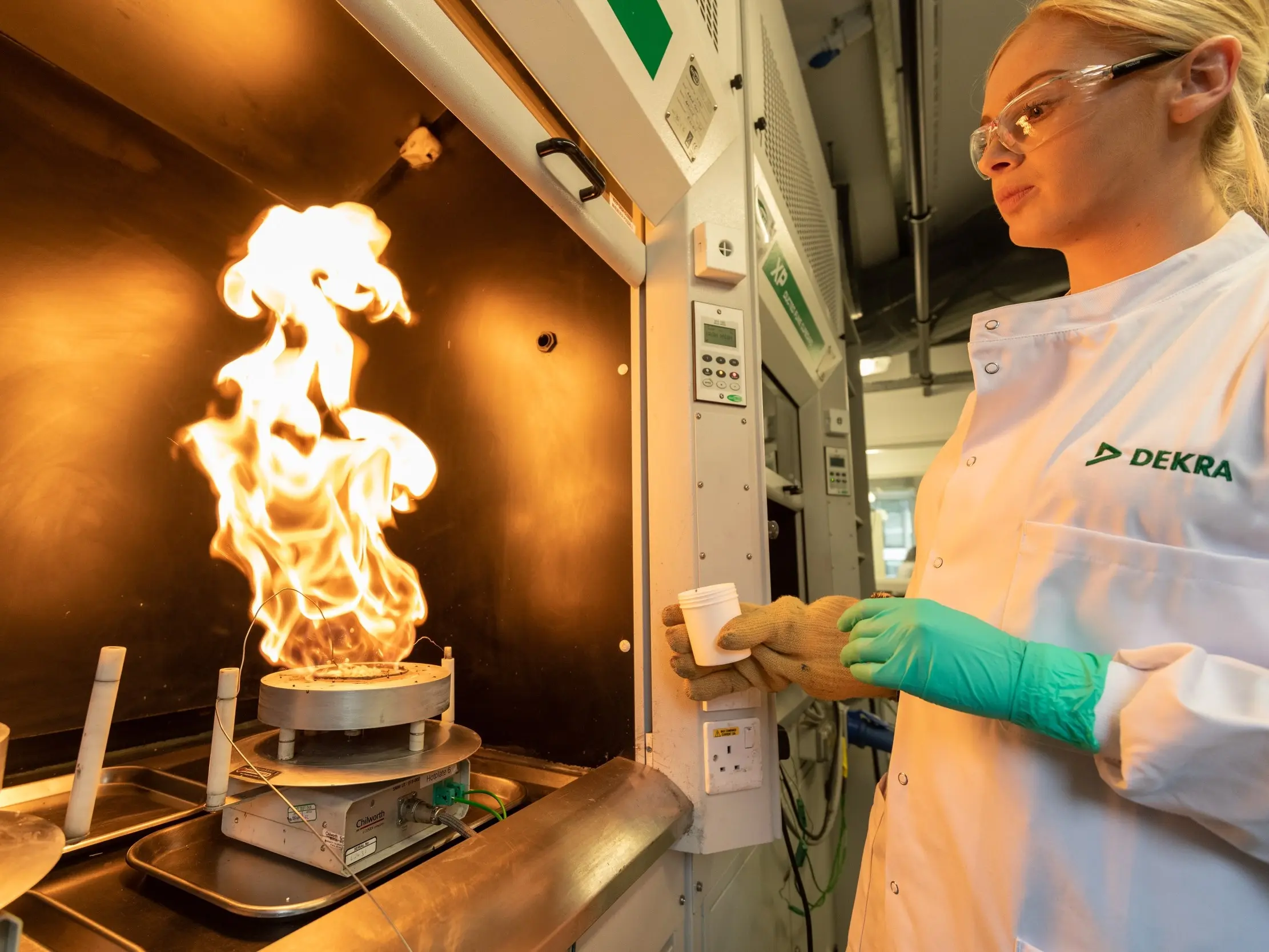
Accelerating Rate Calorimetry
(ARC Testing)
(ARC Testing)
Quantify thermal stability and runaway behavior to support safer scale-up and operation
Accelerating Rate Calorimetry
(ARC Testing)
(ARC Testing)
Quantify thermal stability and runaway behavior to support safer scale-up and operation
HomepageBusiness ServicesConsultingProcess SafetyProcess Safety TestingChemical Reaction Hazard TestingARC Testing (Accelerating Rate Calorimetry)
ARC Testing (Accelerating Rate Calorimetry)
Understand how materials behave as temperature rises, self-heating begins and pressure develops, so you can make better-informed decisions about scale-up, processing, storage and transportation.
What Is ARC Testing?
Accelerating Rate Calorimetry (ARC) is a thermal hazard testing method used to characterize self-heating, temperature rise and pressure generation under near-adiabatic conditions.
ARC testing provides measured, time-based data that can help determine when exothermic activity begins, how rapidly an event develops and how pressure changes as temperature increases. When appropriately interpreted and applied, these data can support hazard evaluations and decisions related to process development, scale-up, operating limits, storage conditions and mitigation strategies.
Do You Need ARC Testing?
ARC testing may be appropriate when you need to understand how a material will behave as heat accumulates, self-heating begins or pressure develops. It can provide deeper insight following thermal screening or help answer specific questions related to scale-up, process changes, storage, transportation and upset conditions.
ARC testing may be appropriate when you need to understand how a material will behave as heat accumulates, self-heating begins or pressure develops. It can provide deeper insight following thermal screening or help answer specific questions related to scale-up, process changes, storage, transportation and upset conditions.
Consider ARC testing if:
- You are scaling from the laboratory to production. Changes in scale can affect heat accumulation and heat removal, making it important to understand self-heating and escalation behavior as part of the broader scale-up assessment.
- Screening identified a possible exotherm. DSC, DTA or another screening method may identify thermal activity without showing how rapidly the event develops or how pressure changes.
- A formulation, raw material or supplier changed. Even a seemingly modest change can affect stability, compatibility or decomposition behavior.
- Storage or transportation conditions are uncertain. Elevated temperatures, confinement or heat accumulation may create conditions that routine handling does not reveal.
- Decomposition may generate pressure or gas. Understanding the rate and magnitude of pressure development can be critical to the broader hazard evaluation.
- You are defining operating boundaries or safeguards. Measured thermal behavior can help inform decisions about temperature limits, upset scenarios and mitigation strategies.
- An unexpected event needs investigation. A temperature rise, pressure excursion, decomposition event or storage incident may warrant further characterization.
What Does ARC Testing Measure?
ARC testing generates a time-based temperature and pressure profile that can be used to evaluate:
- Onset of detectable self-heating or exothermic activity, including decomposition onset
- Rate of temperature rise as the event progresses
- Pressure generation and pressure-rise behavior, including onset of gas generation.
- Gas-generation trends where permanent gas is formed
- Time-based behavior that may support kinetic evaluation, including Time to Maximum Rate (TMR)
- Inputs that may support self-accelerating decomposition temperature (SADT) evaluation for transportation and classification needs, when appropriate for the system and test design
These measurements can provide a more complete picture of thermal behavior than a simple pass/fail screening result.
How Does ARC Testing Work?
ARC testing heats a sample in controlled increments. After each temperature increase, the system pauses and monitors the sample for signs of self-heating.
If self-heating is detected, the instrument follows the event through completion under near-adiabatic conditions. If no self-heating is detected, the test continues stepwise through the defined test range or until exothermic activity is detected or specified end temperature is reached.
This approach is particularly valuable for reactions that accelerate over time because it helps characterize not only whether an event occurs, but also how the event develops over time.
Thermal screening methods such as Differential Scanning Calorimetry (DSC) can help identify whether a material exhibits thermal activity.
When screening identifies a potential concern, additional data may be needed to understand how that behavior could develop under conditions of limited heat loss.
When screening identifies a potential concern, additional data may be needed to understand how that behavior could develop under conditions of limited heat loss.
How Can ARC Data Support Process Safety Decisions?
ARC data can support decisions related to process scale-up, formulation or raw material changes, storage and transportation, operating limits and safeguards. Depending on the process and hazard scenario, the data may also help inform additional testing or engineering evaluation related to pressure-relief design, as well as SADT considerations for transportation and classification.
ARC data can support decisions related to process scale-up, formulation or raw material changes, storage and transportation, operating limits and safeguards. Depending on the process and hazard scenario, the data may also help inform additional testing or engineering evaluation related to pressure-relief design, as well as SADT considerations for transportation and classification.
Advanced and Complex ARC Testing at DEKRA
Some materials and process questions require testing beyond standard conditions.
Some materials and process questions require testing beyond standard conditions.
DEKRA is equipped to support ARC work including:
Our specialists can help define a test plan based on the material, the question that needs to be answered and the decisions the data must support.
- Custom atmospheres
- Gaseous or volatile samples
- Hazardous, pyrophoric or otherwise difficult-to-handle materials
- Non-routine test conditions requiring a tailored approach
- Post-test headspace analysis via Gas Chromatography
Our specialists can help define a test plan based on the material, the question that needs to be answered and the decisions the data must support.
ARC testing may be appropriate when thermal screening identifies potential exothermic activity, when a process is being scaled up or changed, when storage or transportation conditions need to be evaluated, or when more information is needed about self-heating and pressure generation.
DSC and other thermal screening methods can identify thermal activity. ARC testing provides time-based temperature and pressure data that can provide additional insight into how thermal behavior may develop under conditions of limited heat loss.
ARC testing can characterize the onset of self-heating, rate of temperature rise, pressure generation, gas-generation trends and time-based behavior that may support kinetic evaluation, including Time to Maximum Rate (TMR).
Yes. ARC data can support evaluation of process scale-up, formulation or raw-material changes, operating limits and safeguards, as well as certain storage and transportation decisions.
DEKRA specialists can help determine the appropriate testing approach based on your material, process conditions, available screening results and the decision the data needs to support.