
HomepageBusiness ServicesConsultingProcess SafetyProcess Safety TestingCombustible Dust TestingDust Explosibility Screening (Go/No-Go)
Dust Explosibility Screening (Go/No-Go Test, Modified Hartmann Tube)
Understand whether your dust presents an explosion risk—before it impacts your operations.

- Quickly determine if your dust can explode (Go/No-Go result)
- Uses Modified Hartmann Tube screening method
- Supports NFPA 652 and NFPA 660 compliance
- Identifies if further testing (Kst, Pmax) is required
Dust explosions can occur when fine particles become suspended in air and ignite under the right conditions. Without proper screening, materials that appear harmless can present significant explosion risk during handling, processing, or storage.
Dust explosibility screening using the Modified Hartmann Tube provides a rapid, go/no-go determination of whether a dust cloud is capable of propagating an explosion.
What Is Dust Explosibility Screening?
Dust explosibility screening is an initial test used to determine whether a material can form an explosible dust cloud.
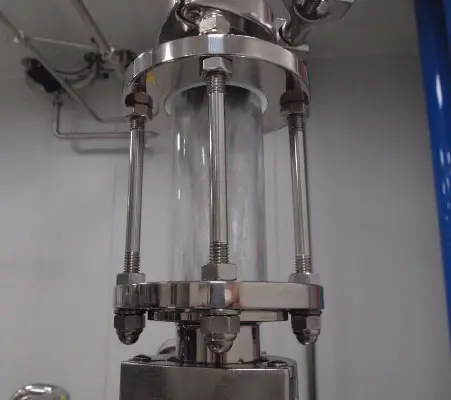
The Modified Hartmann Tube test disperses a dust sample into a vertical tube and applies an ignition source to observe whether flame propagation occurs.
This screening test answers a critical first question: Is the material explosible under dust cloud conditions?
A “Go” result means the dust is capable of propagating an explosion under test conditions and should be treated as a combustible dust hazard.
If a “Go” result is observed, the next step is explosion severity testing (Kst/Pmax) to quantify how strong the explosion could be and support protection system design.
What does the Modified Hartmann Tube test evaluate?
The test provides a qualitative go/no-go result based on observed ignition behavior, including:
- Flame propagation – Determines whether combustion travels through the dust cloud
- Ignition sensitivity – Evaluates how easily the dust ignites under test conditions
- Explosion potential (deflagration screening level) – Identifies whether further explosibility testing is required
This test is designed to quickly identify materials that may present a combustible dust hazard.
Standards and testing context
Dust explosibility screening using the Modified Hartmann Tube is commonly used as an initial evaluation method aligned with industry practices and performed prior to standardized explosion severity testing such as ASTM E1226.
It supports compliance efforts related to combustible dust safety standards, including NFPA 652 and the consolidated NFPA 660 standard, by helping determine whether a material requires further explosibility testing and hazard analysis.
It supports compliance efforts related to combustible dust safety standards, including NFPA 652 and the consolidated NFPA 660 standard, by helping determine whether a material requires further explosibility testing and hazard analysis.
Why Dust Explosibility Screening Matters
Many combustible dust incidents occur because materials were never evaluated for explosibility.
A material does not need to be highly reactive to be explosible under dust cloud conditions, which is why screening is a critical first step.
Screening helps you:
- Identify whether a dust hazard exists
- Determine if further testing (e.g., Kst, Pmax) is required
- Support compliance with combustible dust safety standards
- Reduce uncertainty early in process development
- Prioritize risk mitigation efforts
Real-world example
A food processing facility introduced a new powdered ingredient that appeared non-hazardous. Screening testing revealed the material was explosible under dust cloud conditions, prompting further testing and implementation of explosion protection measures before production began.
Dust Explosibility Screening for Hazard Identification
Modified Hartmann Tube testing is a foundational step in combustible dust hazard analysis.
It is particularly important when:
- Handling powders, fines, or particulate solids
- Introducing new materials or raw ingredients
- Modifying processes that generate dust
- Evaluating byproducts, waste streams, or recycled materials
A “go” result indicates that the material is explosible and should undergo further testing to quantify explosion severity.
Why the Modified Hartmann Tube is used for screening
The Modified Hartmann Tube is designed for rapid hazard identification rather than detailed explosion characterization.
It is widely used as a preliminary deflagration screening tool before quantitative testing such as Kst and Pmax.
Key advantages include:
- Fast, cost-effective screening for explosibility
- Small sample requirements
- Early-stage hazard identification before advanced testing
- Widely accepted screening method in combustible dust analysis
This allows organizations to quickly determine whether additional testing and controls are necessary.
From screening to full dust hazard analysis
Dust explosibility screening is not a standalone evaluation. It is the first step in a broader combustible dust testing strategy.
If a material is determined to be explosible, further testing may include:
This progression ensures that hazards are fully understood and properly managed.
When Is Dust Explosibility Screening Needed?
Dust explosibility screening is typically applied when:
- A material’s explosibility is unknown
- New processes or materials are introduced
- Regulatory or insurance requirements apply
- Conducting a Dust Hazard Analysis (DHA)
- Evaluating changes in particle size or handling conditions
How this fits into combustible dust testing
Dust explosibility screening is often the first step in a broader combustible dust and dust explosion testing program. It provides the initial determination needed before proceeding to quantitative explosion testing and risk assessment.
Frequently Asked Questions
- What is dust explosibility screening?
Dust explosibility screening is a go/no-go test used to determine whether a dust can ignite and propagate an explosion under dust cloud conditions. - Why does dust explosibility screening matter?
It identifies explosion risk early and determines whether further testing and hazard controls are required. - When is dust explosibility screening required?
It is typically required when introducing new materials, modifying processes, or conducting a Dust Hazard Analysis (DHA). - What happens if my dust is explosible?
A “go” result means further testing such as Kst, Pmax, MIE, and MIT is needed to quantify risk.
Why DEKRA
DEKRA combines testing, analysis, and consulting to support comprehensive combustible dust safety.
- Expertise in combustible dust hazards and testing methods
- Integrated testing and consulting capabilities
- Support for Dust Hazard Analysis (DHA) and compliance
- Data-driven approach to hazard identification and risk reduction
Related Services
Get Clarity Before You Move Forward
If you are handling powders or introducing new materials, knowing whether they are explosible is a critical first step. We can help you quickly determine your risk and what to do next.
If your material receives a “Go” result, the next step is Explosion Severity Testing (Kst/Pmax) to understand how strong that explosion could be and design appropriate protection.
Check if Your Dust is Explosible