ASTM Testing Services

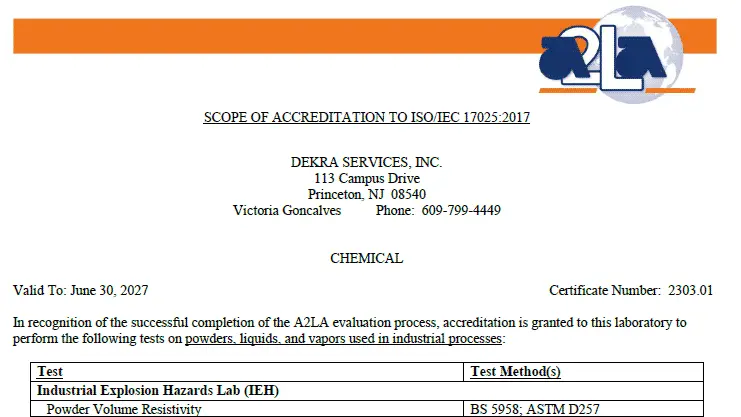
DEKRA offers many standardized tests that can be conducted in our ISO/IEC 17025 accredited laboratory. Our most popular standardized test methods address the following:
  • Aerosol Flammability
  • Chemical and Physical Properties
  • Chemical Reactivity
  • Combustible Dust Hazards
  • Electrostatic Properties
  • Flash Point, Fire Point, Flammable Limits
  • Minimum Ignition Energy
A list of frequently requested ASTM Methods is provided below.
ASTMASTM Test Method
ASTM D56Flash Point by Tag Closed Cup Tester
ASTM D92Flash and Fire Points by Cleveland Open Cup
ASTM D93Flash Point by Pensky-Martens Closed Tester
ASTM D257DC Resistance or Conductance of Insulation Materials
ASTM D924Dissipation Factor (or Power Factor) and Relative Permittivity (Dielectric Constant) of Electrical Insulating Liquids
ASTM D1169Specific Resistance (Resistivity) of Electrical Insulating Liquids
ASTM D1816Dielectric Breakdown Voltage of Insulating Oils of Petroleum Origin Using VDE Electrodes
ASTM D1929Determining Ignition Temperature of Plastics
ASTM D2624Electrical Conductivity of Aviation and Distillate Fuels
ASTM D2717Thermal Conductivity of Liquids
ASTM D2879Vapor Pressure-Temperature Relationship and Initial Decomposition Temperature of Liquids by Isoteniscope
ASTM D3065Flammability of Aerosol Products
ASTM D3278Flash Point of Liquids by Small Scale Closed-Cup Apparatus
ASTM D4206Sustaining Burning of Liquid Mixtures Using the Small Scale Open-Cup Apparatus
ASTM D4308Electrical Conductivity of Hydrocarbons by Precision Meter
ASTM D4359Determining Whether a Material Is a Liquid or a Solid
ASTM D4470Static Electrification
ASTM D4496DC Resistance or Conductance of Moderately Conductive Materials
ASTM D4865Generation of Static Electricity in Petroleum Fuel Systems
ASTM E537Assessing the Thermal Stability of Chemicals by Methods of Thermal Analysis
ASTM E582Minimum Ignition Energy and Quenching Distance in Gaseous Mixtures
ASTM E659Autoignition Temperature of Liquid Chemicals
ASTM E681Concentration Limits of Flammability of Chemicals
ASTM E771Spontaneous Heating Tendency of Materials
ASTM E918Concentration Limits of Flammability of Chemicals at Elevated Pressure
ASTM E1194Vapor Pressure
ASTM E1226Pressure and Rate Rise for Combustible Dusts
ASTM E1232Temperature Limit of Flammability of Chemicals
ASTM E1491Minimum Autoignition Temperature of Dust Clouds
ASTM E1515Minimum Explosible Concentration of Combustible Dusts
ASTM E1549MESD Controlled Garments Required in Cleanrooms and Controlled Environments for Spacecraft for Non-Hazardous and Hazardous Operations
ASTM E1618Standard Test Method for Ignitable Liquid Residues in Extracts from Fire Debris Samples by Gas Chromatography-Mass Spectrometry
ASTM E2019Minimum Ignition Energy of a Dust Cloud in Air
ASTM E2021Hot-Surface Ignition Temperature of Dust Layers
ASTM E2079Limiting Oxygen (Oxidant) Concentration in Gasses and Vapors
ASTM E2105Standard Practice for General Techniques of Thermogravimetric Analysis (TGA) Coupled with Infrared Analysis (TGA/IR)
ASTM G72Autogenous Ignition Temperature of Liquids and Solids in a High Pressure Oxygen-Enriched Environment
Frequently Asked Questions (FAQs) About ASTM Testing
ASTM testing refers to laboratory testing performed according to standardized procedures developed by ASTM International. These ASTM test methods provide consistent ways to evaluate product characteristics, performance, safety, and material properties.
ASTM standard testing helps organizations generate reliable data, compare products consistently, and support regulatory, industry, and customer requirements. The results can also inform decisions related to product development, manufacturing, quality assurance, and safety.
ASTM laboratory testing can evaluate a wide range of materials, chemicals, industrial goods, consumer products, packaging, and manufacturing applications. The appropriate standard and test method depend on the product, its intended use, and the characteristics being evaluated.
Organizations often use ASTM testing services during product development, formulation changes, quality assurance programs, compliance evaluations, product certification efforts, and investigations involving performance or safety concerns. Testing may also be appropriate before entering a new market or responding to customer requirements.
Yes. ASTM compliance testing can support regulatory initiatives, customer requirements, industry standards, transportation classifications, and product safety evaluations. ASTM standards are frequently referenced by regulatory agencies and industry organizations, although the specific requirements vary by product and application.
The appropriate ASTM test method depends on the material, product, process, hazard, or performance characteristic being evaluated. An experienced ASTM testing laboratory can review the testing objective and help identify the most relevant standards and procedures.
ASTM testing services are widely used across the chemical, manufacturing, consumer product, transportation, packaging, pharmaceutical, construction material, energy, and industrial product sectors. Testing requirements vary according to the product, application, market, and applicable standards.
Depending on the selected method, ASTM testing can provide information about safety, performance, flammability, material properties, compatibility, durability, transportation classification, and regulatory requirements. The resulting data can support technical evaluations and informed product decisions.
After ASTM laboratory testing is completed, organizations typically receive test results, technical documentation, and supporting data. These materials can be used for product development, compliance activities, customer requirements, internal evaluations, and regulatory submissions.
An independent ASTM testing laboratory provides specialized expertise, standardized procedures, objective results, and supporting documentation. Organizations sometimes refer to this service as ASTM certified testing, but ASTM International does not generally certify laboratories or test results. It is important to confirm the laboratory’s qualifications, applicable accreditations, and ability to perform the required ASTM test methods.
Find us on:
linkedinfacebookyoutube
Share page :